The Everyday Chef's Knife: What to Look For Before You Buy
One good chef's knife does most of the work in a home kitchen. Learn how to judge blade length, steel, handle and balance, and which well-known models suit which cook.
Saffron CrustEP-101
We may earn a commission if you buy through links in this guide. How we make money
Victorinox Fibrox Pro 8-inch chef's knife
A widely recommended budget knife with a grippy handle and a blade that is easy to sharpen.
You do not need a block of twelve knives. A chef's knife, a small paring knife and a serrated bread knife cover nearly everything. Of those three, the chef's knife does the heavy lifting, so it is the one worth getting right.
Here is what to check before you buy, in the order that matters most.
Fit in your hand
This beats any spec. A knife that feels awkward will slow you down and tire your wrist. If you can, hold one in a store. If you shop online, read the handle shape and weight.
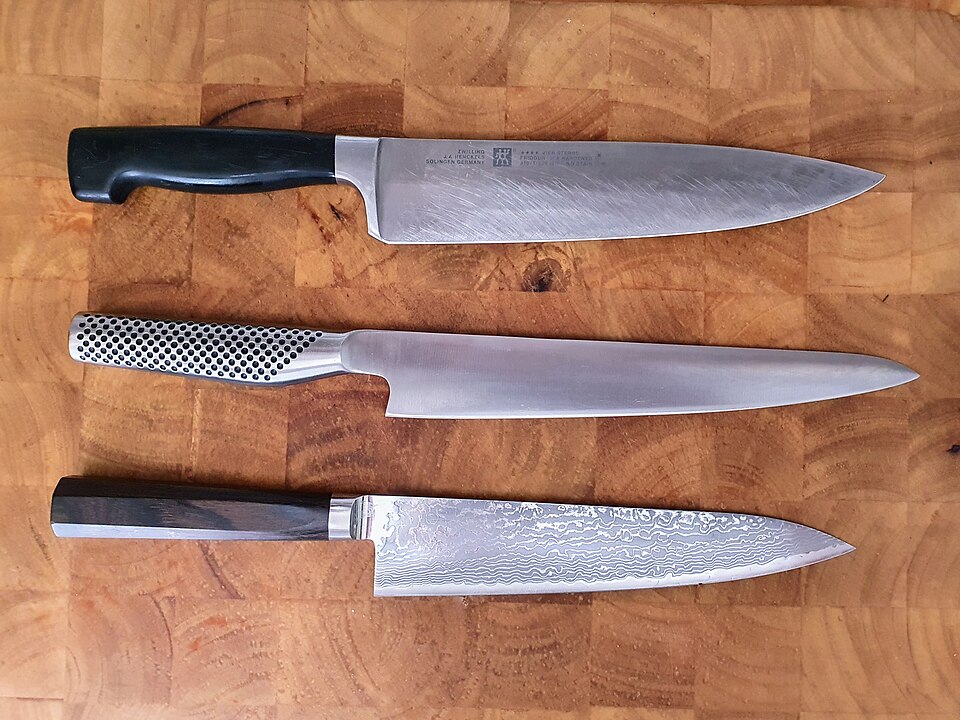
- Blade length. Eight inches is the standard. Six or seven inches suits smaller hands or tight counters. Ten inches is for people who want more reach.
- Weight and balance. Heavier German-style knives feel solid and push through dense food. Lighter Japanese-style knives feel nimble and cut thin slices.
- Handle. Textured plastic grips well when wet. Wood looks good but needs care. Full-metal handles can be slippery.
Steel and construction
Steel decides how long the edge lasts and how much upkeep the knife needs.
| Type | Edge | Upkeep | Suits |
|---|---|---|---|
| Stainless steel | Holds an edge well enough, easy to resharpen | Low, resists rust | Most home cooks |
| High-carbon stainless | Sharper, holds longer | Low to medium | Cooks who sharpen occasionally |
| Carbon steel | Very sharp, patina over time | High, rusts if left wet | Hobbyists who enjoy care |
| Ceramic | Stays sharp long, brittle | Chips if dropped | Light slicing only |
Forged knives are made from one hot-pressed piece and often have a bolster, a thick section between handle and blade. Stamped knives are cut from a sheet, weigh less, and usually cost less. Good stamped knives are fine for everyday cooking. Forged ones feel more substantial, and that matters to some people more than others.
Some well-known models
- Victorinox Fibrox Pro 8-inch: a long-time budget favorite with a stamped blade.
- Mercer Culinary Millennia: another budget option often used in culinary schools.
- Wusthof Classic: a forged German knife, mid-range to premium, with a full bolster.
- Henckels Classic: a forged line in a similar style and price range.
- Tojiro DP gyuto: a lighter Japanese-style knife, mid-range.
- Global G-2: a Japanese knife with a metal handle, popular for its thin, sharp edge.
Opinions vary, and any of these can be a fine choice. Read the specs and, if you can, handle one first.
Care that keeps it sharp
- Hand wash and dry right away. Dishwashers dull edges and can damage handles.
- Use a wood or plastic cutting board. Glass, stone and ceramic boards dull a blade fast.
- Hone often. A honing steel realigns the edge. Use it every few uses.
- Sharpen once or twice a year. Use a whetstone or a pull-through sharpener, or a local sharpening service.
- Store it safely. A magnetic strip, a block, or a blade guard in a drawer protects both the edge and your fingers.
A sharp knife is safer than a dull one, since a dull blade slips. Cut away from your hand, and keep your fingers curled in a claw grip.
Who should buy which
A new cook who wants one reliable knife for a low price can start with a stamped stainless model and spend the savings on a sharpener. Someone who cooks every night and likes a heavy, confident feel may enjoy a forged German knife. A cook who slices lots of vegetables thinly may prefer a lighter Japanese-style blade, though the harder steel can chip if you twist it through bones or frozen food. Left-handed cooks should check that the edge is ground evenly on both sides. Most chef's knives are, but a few Japanese knives are ground for right-handed use.
What to pair it with
A good knife works better with a few helpers: a large cutting board, a honing steel, and a bench scraper. If you are building your kitchen from scratch, our starter baking kit lists basic tools, and our post on cast iron versus nonstick skillets covers the pan you will use the knife with.
The bottom line
Choose an 8-inch knife that feels comfortable and is made of stainless or high-carbon stainless steel. If you want a low-cost, low-fuss pick, a Victorinox Fibrox is a common starting point. If you want a heavier feel, try a forged German knife. Then spend a few minutes a month on honing, and it will serve you for years.
Photo: T. Bjornstad, CC BY-SA 4.0, via Wikimedia Commons.