Portable Chargers: How to Read mAh and Watts
A power bank label is mostly two numbers. Learn what mAh and watts mean, how many phone charges to expect, and which size fits a commute, a trip, or a laptop.
Cobalt SignalEP-318
We may earn a commission if you buy through links in this guide. How we make money
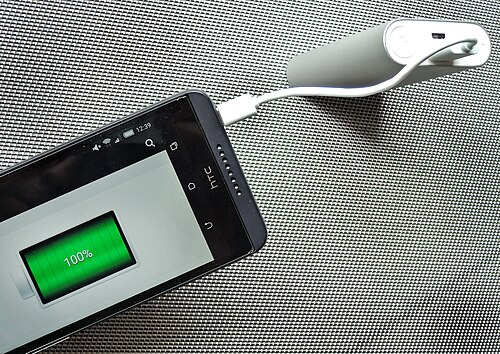
A 10,000 mAh USB-C power bank with 20-watt output
It charges a phone about two times, fits a pocket, and works on a plane.
Every power bank box shouts a big number, usually in mAh. That number tells you how much energy is inside. A second, smaller number in watts tells you how fast it can send that energy out. You need both to pick the right one.
Short version: for a phone, 10,000 mAh with at least 20 watts of output is the sweet spot. For a laptop, you need a bigger bank with a much higher wattage. The rest of this guide explains why.
What mAh actually means
mAh stands for milliamp-hours. It is a measure of capacity, like the size of a gas tank. A phone battery is often somewhere around 3,000 to 5,000 mAh, so a 10,000 mAh bank sounds like it should charge a phone two to three times.
In practice you get less. A power bank loses some energy as heat while it converts its internal battery voltage to the voltage your phone wants. A common rule of thumb is to expect roughly 60 to 70 percent of the printed capacity to reach your device. So a 10,000 mAh bank gives about two full charges for a typical phone, not three.
What watts mean
Watts measure speed. Watts equal volts times amps, but you only need the final number. A bank that outputs 5 watts will fill a modern phone slowly. One that outputs 20 watts or more can fast charge, if the phone supports it.
Two things have to match: the power bank and the phone. Look for these labels on the bank:
- USB-C Power Delivery (PD). The common fast-charging standard for recent iPhones, Android phones, tablets and many laptops.
- PPS. A PD extension some Android phones use for their fastest charging.
- Output per port. Some banks list a big total, then split it when two ports are in use. Check the number for a single port.
How to choose a size
| Size | Best for | Trade-off |
|---|---|---|
| 5,000 mAh | A top-up on the commute | Under one full phone charge in many cases |
| 10,000 mAh | Daily carry, weekend trips | About the size of a deck of cards |
| 20,000 mAh | Long trips, phone plus tablet | Heavier, around a pound or more |
| 25,000 mAh and up, 65+ watts | Charging a laptop | Bulky, and airline limits apply |
A few real options to look at
These are product lines worth a look, not rankings. Specs change by model, so read the label before you buy.
- Anker power banks in the 10,000 mAh range: a long-running line with PD and compact shapes.
- Apple MagSafe battery pack: a wireless snap-on for iPhones, simple but slower than a cable.
- INIU slim power banks: budget-friendly, thin, good for pockets.
- Baseus high-output banks: options with 65-watt output for laptops.
- Belkin BoostCharge banks: a mid-range line with a clean, simple design.
Flying and travel notes
Lithium batteries go in your carry-on, never in checked bags. Most airlines allow banks up to 100 watt-hours without special approval, and 10,000 mAh and 20,000 mAh banks fall under that limit. The watt-hour number is printed on most banks. If it is not, check the airline's rules before you fly. For more on packing small electronics, see our guide to the travel tech pouch.
Small things that matter
- Bring a good cable. A weak cable can limit speed no matter how strong the bank is. Use a USB-C cable rated for the wattage you want.
- Pass-through charging lets you charge the bank and your phone at once, handy in a hotel with one outlet.
- Recharge the bank itself. A big bank with a slow input can take many hours to refill. Look for USB-C input of 18 watts or more.
- Buy from a known brand. Cheap, unbranded banks often overstate their capacity.
If you also use wireless earbuds on the road, our earbuds buying guide covers how long their cases hold a charge.
Safety and lifespan
Use the cable that came with the bank, or a known brand. Do not charge a bank under a pillow or in a hot car, and stop using one that swells, gets very hot or smells odd. Lithium batteries wear out. Expect a few hundred full charge cycles before capacity drops, and replace the bank when it no longer holds enough for a day.
The bottom line
Ignore the biggest number on the box. Pick a capacity that fits how you travel, then check the watts and the PD label. A 10,000 mAh, 20-watt USB-C bank covers most people. Step up to 20,000 mAh for long days away from an outlet, and only go to a high-wattage model if you plan to charge a laptop.
Photo: Mk2010, CC BY-SA 4.0, via Wikimedia Commons.